

If Sunday night turns into unpaid bills, mystery leftovers, and a laundry pile by the door, use a weekly reset routine for home and budget that takes 45 minutes instead of the whole day. You will check money, meals, clutter, laundry, and the next 3 days before the week starts making decisions for you.
Fast win: Set a 45-minute timer and do only five passes: 10 minutes for money, 15 for meals, 10 for one home zone, 5 for laundry, and 5 for the calendar. Do not buy a planner, bins, or a command center first; use your phone notes, a scrap envelope, or one $1.25 Dollar Tree folder until the routine proves it helps.
45-Minute Weekly Reset Checklist
| Minute | Reset Area | Do This First | Done Looks Like |
|---|---|---|---|
| 0-10 | Money | Open bank/card activity and mark surprises | you know what changed this week |
| 10-25 | Meals | Pick 3 dinners and 1 backup meal | grocery gaps are written down |
| 25-35 | Home | Reset one visible trouble spot | counter, entryway, or table is usable |
| 35-40 | Laundry | Move one load one step forward | wash, dry, fold, or put away happens |
| 40-45 | Calendar | Check the next 3 days | errands, bills, and appointments are visible |
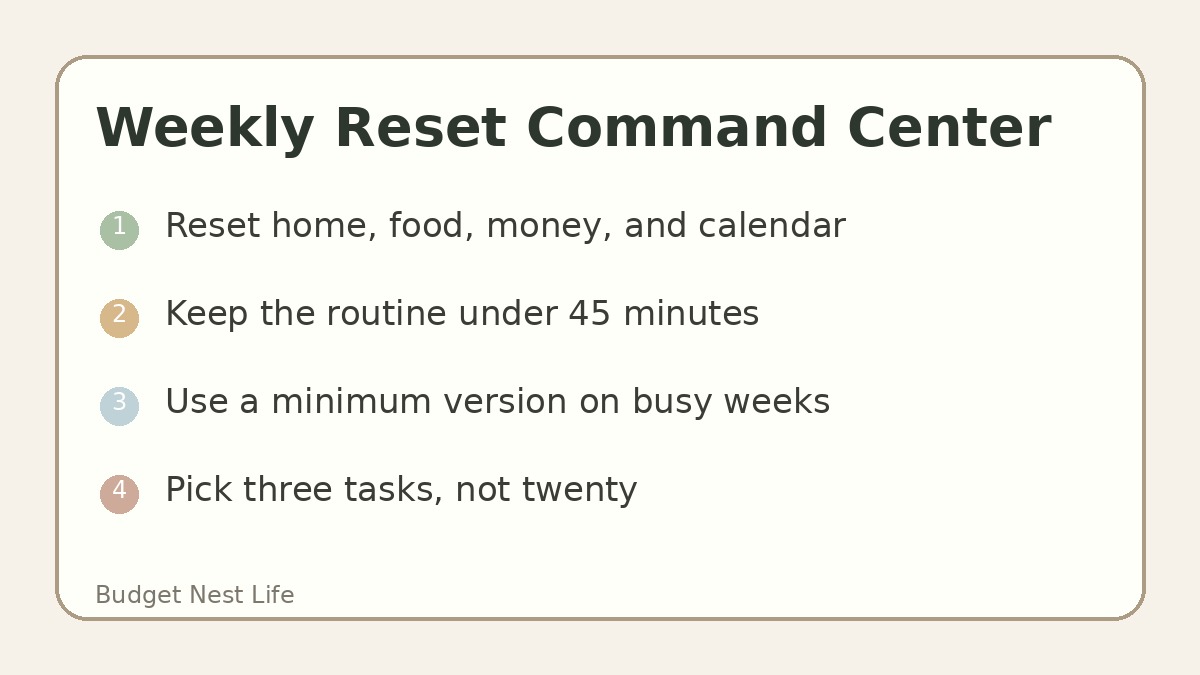
This is not a deep-cleaning day. It is a short control panel for the parts of the week that usually cost money, time, or patience when they stay vague.
Why a Weekly Reset Works Better Than a Big Monthly Catch-Up
A monthly reset waits until the problem is already expensive. A weekly reset catches the $18 Target run, the produce hiding behind takeout containers, and the school form due Tuesday before they turn into a scramble.
Use the routine on the same day each week if you can, but do not make the day sacred. Friday afternoon, Sunday evening, or Monday morning can all work. The better test is whether you can finish the five passes in under an hour with the house in a normal messy state.
A realistic reset also respects small homes and rentals. If your kitchen table is your desk, homework spot, and folding station, clear enough space to pay a bill, pack a lunch, or set out tomorrow’s keys without moving ten piles first.
The 10-15-10-5-5 Reset Map
The original piece of this routine is the 10-15-10-5-5 Reset Map. It puts a hard edge around each pass so the reset does not expand into a four-hour cleaning project.
| Reset Pass | Time Limit | What to Touch | What to Ignore |
|---|---|---|---|
| Money check | 10 minutes | recent charges, upcoming bills, cash left | full budget redesign |
| Meal check | 15 minutes | leftovers, 3 dinners, grocery gaps | 14 new recipes |
| Home check | 10 minutes | one surface or drop zone | closets and hidden storage |
| Laundry check | 5 minutes | one load or one basket | every piece of laundry |
| Calendar check | 5 minutes | next 3 days only | the whole month |
When the timer ends, move on. A weekly reset routine for home and budget works because it repeats. If you try to solve every category every Sunday, you will avoid it by week three.
Step 1: Do a 10-Minute Money Sweep
Start with money because it changes what you can say yes to during the rest of the reset. Open your bank app, credit card app, or paper receipts. Look for three things only: charges you forgot, bills due in the next 7 days, and categories that are already tight.
Here is a simple sweep you can copy:
- Write the current checking balance or cash available.
- List bills due before next reset day.
- Circle any surprise charge over $10.
- Check whether groceries, gas, or household supplies need a smaller week.
- Move one task to the calendar, such as paying a utility bill on Thursday.
If you already use grocery budget categories, this is where they help. You are not judging every receipt. You are noticing whether food, snacks, household items, or takeout are the category that needs attention this week.
Step 2: Pick 3 Dinners Before You Write a Grocery List
The meal pass should protect your grocery budget from panic shopping. Check the fridge first, then the pantry, then the freezer. Write down food that needs to be used soon, especially cooked meat, open salad greens, yogurt, berries, tortillas, or leftovers.
Choose only three dinners for the week. Three is enough because most homes also have leftovers, easy breakfasts, one busy night, or one pantry meal. If you plan seven brand-new dinners, the list usually gets longer than the week.
A US reader example: if you have rice, eggs, half a bag of frozen vegetables, tortillas, and a can of beans, your three dinners could be fried rice, bean quesadillas, and breakfast-for-dinner. That might mean buying only salsa, apples, and milk instead of building a full cart from scratch.
Planning a larger grocery run? Use the two-week grocery list system for the main shop, then use this reset between trips so leftovers and fragile produce get used before they spoil.
Step 3: Reset One Home Zone That Costs You Time
Do not walk around the whole house picking up random items. Choose the zone that creates the most friction during the week. Common choices are the kitchen counter, entryway, dining table, laundry chair, bathroom sink, or the floor beside the bed.
Use this 10-minute rule:
| Problem Zone | 10-Minute Reset | Money Connection |
|---|---|---|
| Entryway | return shoes, keys, mail, and bags to one spot | fewer lost-item replacements |
| Kitchen counter | clear trash, dishes, receipts, and grocery notes | fewer duplicate grocery buys |
| Dining table | remove papers and set up one usable seat | easier bill check or meal prep |
| Bathroom sink | toss empties and group daily items | less impulse buying toiletries |
| Laundry chair | sort one basket into keep, wash, put away | fewer emergency clothing purchases |
If you are tempted to buy a $35 basket set, pause. Try a free container first: a shoebox for mail, a mug for pens, or a reusable bag for library returns. If the same zone still fails for 3 weeks, then a small purchase may be worth it.
Step 4: Move Laundry One Step, Not Ten Steps
Laundry can swallow a reset because it has too many stages. The goal is one forward move. Start a load, switch a load, fold towels, put away work clothes, or gather clothes for Monday. Any one of those counts.
For a family or shared apartment, make the rule visible: Sunday reset laundry is for the next 3 days, not every sock in the house. That could mean work shirts, school clothes, uniforms, gym clothes, or towels. The rest can wait for its normal laundry day.
This is also where a budget connection shows up. When clean basics are easy to find, it is easier to avoid last-minute buys like extra socks, backup leggings, or convenience laundry products you did not plan to buy.
Step 5: Check the Next 3 Days, Not the Whole Month
A calendar reset should make Monday through Wednesday calmer. Look at appointments, work shifts, school events, bill due dates, trash day, library books, grocery pickup windows, and errands that require driving.
Write the top three tasks on one sticky note or phone note:
- one money task, such as pay the electric bill by Tuesday;
- one home task, such as put the donation bag in the car;
- one food task, such as thaw chicken or cook rice.
Keep the list short. If the weekly reset ends with 19 tasks, it creates more pressure than relief. Three tasks give your week a starting point without pretending you can control every hour.
The Sunday Spillover Rule
The Sunday Spillover Rule is simple: anything not finished during the 45-minute reset must move to a specific day or disappear from the list. It cannot float around as guilt.
| Unfinished Item | Move It To | Drop It If |
|---|---|---|
| full pantry cleanout | Tuesday 15-minute shelf check | you only needed dinner ideas |
| budget category cleanup | Thursday after payday | no spending problem showed up |
| laundry catch-up | normal laundry day | next 3 days have clean clothes |
| meal prep | Monday rice or pasta batch | dinners are already covered |
| store return | next errand route | return value is not worth the trip |
This rule protects the reset from becoming a second job. You are allowed to stop when the timer ends.
Budget-Friendly Tools to Use Before You Buy Anything
A weekly reset routine for home and budget does not need matching bins or a printed binder. Try the $0 version for 2 weeks first.
| Need | $0 Option | Low-Cost Option If It Keeps Working |
|---|---|---|
| weekly checklist | phone notes app | $5 notebook from Target or Walmart |
| bill holding spot | envelope from mail | $1.25 Dollar Tree folder |
| grocery gap list | back of a receipt | magnetic notepad |
| drop zone | shoebox or tote bag | small tray near the door |
| timer | phone timer | kitchen timer if phones distract you |
If a tool makes the reset faster every week, it may earn a place. If it only looks cute, wait.
Common Weekly Reset Mistakes
Starting with a full house clean
Cleaning the whole house before checking bills or food can use all your energy while the expensive problems stay hidden. Do the five passes first. If you still have time, add cleaning.
Making the grocery list before checking leftovers
This is how duplicate sour cream, extra bread, and another bag of lettuce end up in the cart. Check what needs to be eaten before writing the list.
Turning the reset into a shopping trigger
A messy entryway does not automatically mean you need a bench, baskets, hooks, and labels. Use what you have for 7 days, then decide whether the same problem remains.
Skipping the money sweep because it feels stressful
A 10-minute sweep is not a full budget meeting. It is a quick look at what already happened and what is due next. For basic setup help, the Consumer.gov guide to making a budget is a plain-language reference.
FAQ
What day is best for a weekly reset routine?
The best day is the one before your busiest stretch. For many households that is Sunday, but a Thursday reset can work better if groceries, payday, or work schedules happen before the weekend.
How long should a weekly home and budget reset take?
Aim for 45 minutes. If you only have 15 minutes, do money, meals, and the next 3 days. Save the home zone and laundry pass for later.
What should I include in a weekly budget reset?
Check recent charges, upcoming bills, grocery needs, and one category that tends to leak money. If impulse buys are the issue, use a wait list like the one in how to stop impulse buying.
Do I need a printed weekly reset checklist?
No. A phone note, receipt, or notebook page works. Print or buy a checklist only after you know which five tasks you repeat every week.
Final Takeaway
A weekly reset routine for home and budget should leave you with five clear answers: what money needs attention, what dinners are covered, which home zone is usable, what laundry moved forward, and what must happen in the next 3 days. If you get those answers in 45 minutes, the reset did its job.