

If you want to know how to stop impulse buying, do not start by promising you will never buy anything fun again. Start by adding friction. A 24-hour wait list gives every “I need this” item a place to go before it becomes a charge on your card.
Do this today: when you want to buy something unplanned, write down the item, price, trigger, and what problem it solves. Wait 24 hours for small items and 7 days for bigger purchases. Most impulse buys lose power when they have to survive a normal day.
The 24-Hour Wait List
| Field | Example |
|---|---|
| Item | black storage basket |
| Price | $18 |
| Trigger | saw a pantry photo online |
| Problem it solves | snacks look messy |
| Wait time | 24 hours |
| Budget category | home organization |
| Decision | use an old bin first |
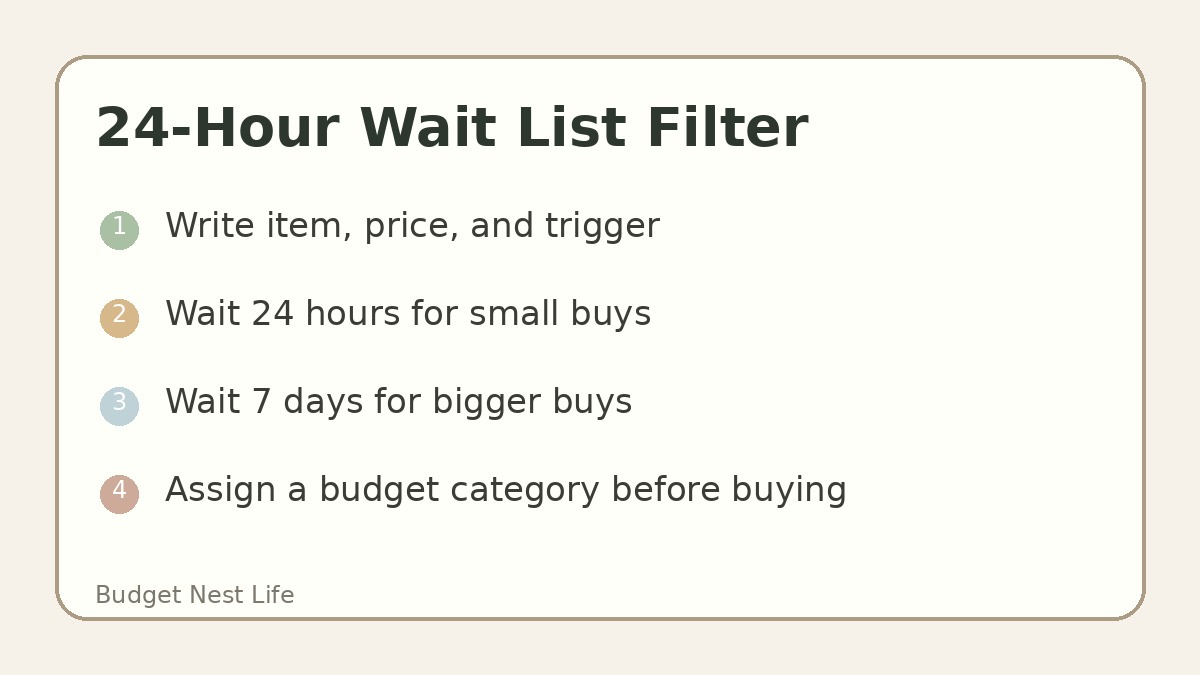
The list is not a punishment. It is a pause button. You are allowed to buy useful things; you are just making the item explain itself first.
Why Impulse Buying Happens
Most impulse purchases are not random. They usually come from one of these patterns:
| Trigger | What It Sounds Like | Better Rule |
|---|---|---|
| Stress | “I deserve this after today.” | write it down and close the app |
| Sale pressure | “It is only available today.” | wait 24 hours unless it was already planned |
| Boredom | “I am just looking.” | make a free reset list instead |
| Comparison | “Her home looks better.” | identify the actual problem in your space |
| Convenience | “I need this right now.” | check whether you own a workaround |
When you know the trigger, the solution becomes smaller. You do not need a whole new personality; you need a better rule at the exact moment you usually buy.
The Cart Audit Before Checkout
Before buying, ask five questions:
- Did I want this before I saw it today?
- What problem will it solve this week?
- Do I already own something that can do the job?
- Which budget category pays for it?
- What will I remove or delay if I buy it?
If an item cannot pass these questions, it goes back to the wait list.
Spending Rules That Still Allow Fun
Strict budgets often fail because they remove all small pleasures. Use limits instead.
| Rule | How It Works |
|---|---|
| Fun money cap | planned small purchases are allowed inside a fixed amount |
| One-in, one-out | buy a new home item only if one item leaves |
| 24-hour small item rule | wait one day for unplanned low-cost items |
| 7-day larger item rule | wait a week for higher-cost items |
| No home-screen shopping apps | remove the easiest trigger |
The goal is not to make every purchase serious. The goal is to stop unplanned purchases from making decisions for you.
A $50 Impulse Audit
Look at the last 30 days and list small purchases you barely remember.
| Purchase | Cost | Trigger | Keep or Learn? |
|---|---|---|---|
| storage bin | $18 | saw a pretty closet | learn: measure first |
| extra snacks | $12 | hungry while shopping | learn: shop after eating |
| sale candle | $9 | limited-time deal | learn: wait list |
| app add-on | $5 | boredom | learn: remove saved card |
| fast takeout | $16 | no backup meal | learn: keep pantry dinner |
Even a few small purchases can show the pattern. If three $18 items are paused in a month, that is $54 back for groceries, debt, savings, or a planned purchase.
Replacement Actions for the Moment You Want to Buy
- Put the item on the wait list.
- Delete one old cart.
- Move the app off your phone’s home screen.
- Add the price to a “money kept” note.
- Clean or reset the area you wanted to improve.
- Check your things to stop buying to save money list.
A replacement action matters because “just don’t buy it” leaves a gap. The gap is where the cart comes back.
Common Mistakes
Turning the wait list into a wish list
A wait list needs a review day and a budget category. Without those, it becomes a shopping list with extra steps.
Removing every fun purchase
That usually leads to rebound spending. Keep planned fun money if your budget allows it.
Ignoring time of day
Many impulse buys happen at night, after work, or while scrolling. Put the strongest rule at your weakest time.
Saving cards everywhere
The easier checkout is, the faster impulses become purchases. Remove saved cards from stores that trigger you most.
Helpful Source
For basic budget setup, see Consumer.gov’s budgeting guide. A wait list works best when every purchase has a category.
FAQ
What is the fastest way to stop impulse buying?
Use a 24-hour wait list for every unplanned purchase. Write the item, price, trigger, and budget category before checkout.
Should I delete shopping apps?
If shopping apps trigger late-night or stress purchases, remove them from your home screen or delete them for 30 days. Make buying less automatic.
What if the item is on sale?
If you did not plan to buy it before seeing the sale, it still goes on the wait list. A discount on an unplanned item is still spending.
How do I stop impulse buying without feeling deprived?
Create a small planned fun-money category. The point is to separate planned enjoyment from reactive buying.
The “Use What You Own First” Reset
Many impulse buys are really organization problems, boredom problems, or stress problems. Before checkout, try a no-spend version for 24 hours.
| Want to Buy | Try First |
|---|---|
| new storage basket | empty one drawer or reuse a box |
| new planner | write tomorrow’s list on paper |
| new cleaning product | use the product already open |
| new clothes | make three outfits from what you own |
| takeout | use one backup meal |
If the no-spend version solves the problem, the purchase was optional. If the problem still shows up three times, then a planned purchase may be reasonable.
Make Your Phone Less Expensive
A lot of impulse buying starts before the store. Change the phone setup.
- Remove shopping apps from the home screen.
- Turn off promotional push notifications.
- Delete saved carts once a week.
- Unsave payment cards from stores that trigger you.
- Move deal emails to a folder instead of your inbox.
These changes do not require willpower every night. They make the impulse path longer.
What to Do When You Still Want the Item
After the wait time, you can still buy the item if it fits the budget and solves a real problem. The point is not automatic denial. The point is a cleaner decision. If you still want it, choose the category, check the balance, and decide what tradeoff you accept. Planned buying is different from impulse buying.
Final Takeaway
Impulse buying gets easier to control when every want has to pause, name its trigger, and fit a budget category. The 24-hour wait list is simple, but it changes the moment where the money usually leaves.