
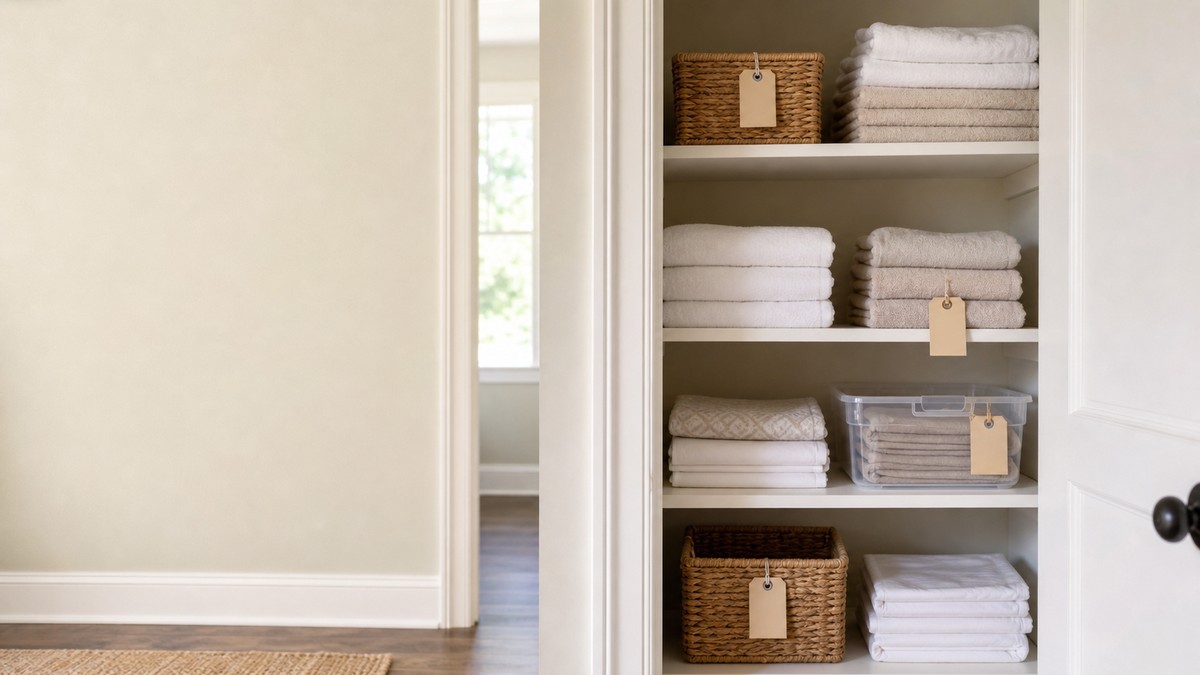
When towels slide forward and spare sheets hide behind half-used bottles, linen closet organization on a budget starts with one shelf—not a cart full of bins. Use a 45-minute reset to sort what you reach for, map the shelf sizes, and spend $0 unless a measured gap earns an upgrade.
Fast win: Set a 10-minute timer and empty one eye-level shelf. Make three piles: daily linens, backup linens, and relocate; return only the daily pile before deciding whether you need even one basket. This costs $0 and shows the shelf space you actually have.
The Keep-Count Worksheet: Start With What Gets Washed
| Linen type | Adjustable starting point | Keep on the main shelf | Move, donate, or relocate when… |
|---|---|---|---|
| Bath towels | 2 per regular user | The set in use plus the next clean set | Extras have not been used through two laundry cycles |
| Hand towels | 2 per bathroom | One stack near the front | The stack keeps toppling or duplicates another bathroom’s supply |
| Sheet sets | 2 per regularly used bed | One current set and one backup | A set does not fit the bed or has been bypassed for months |
| Light blankets | 1 per bed or couch that uses one | Folded on a lower shelf | It belongs to a guest room, car, or seasonal rotation |
| Washcloths | A small open handful per bathroom | A short, easy-to-count stack | The pile spills into the towel zone |
These are adjustable starting points, not a rule about how many linens every household should own. Change the numbers for your laundry schedule, household size, guests, climate, pet messes, and closet depth. The useful question is: can you wash and put away the next set before you run out?
Write your number beside each row before folding. A crowded shelf means reduce the count or move a category, not buy a larger container.
Do the $0 Reset Before Buying a Single Bin
Give the closet 20 minutes before you shop. Remove empty packaging, damaged linens, and stacks no one uses. Match sheet pieces to their bed size before deciding what stays.
Separate linens from supplies. Put bathroom items in under-bathroom-sink organization zones. Items that travel room to room belong in a simple cleaning caddy checklist, not behind towels.
Keep a donation bag with a 30-day review date. If nobody retrieves a clean, useful item, pass it along locally. For end-of-life materials or reuse ideas, see EPA guidance on recycling and reuse.
Measure Before You Buy Bins for a Deep Shelf
A bin can waste 2 inches of depth or block sheets behind it. Measure each shelf’s inside width, depth, and height, plus brackets, hinges, and door swing.
Use the Shelf-Size-First Map below before choosing a container. It assigns each shelf by access and item weight, so the closet works even if you use shoe boxes, clean delivery boxes, or nothing at all.
| Shelf position | Best use | Measure or rule to check | $0 setup first |
|---|---|---|---|
| Eye level | Daily bath towels and hand towels | Leave 1 inch above the stack so it slides out | Stack by size, largest at the bottom |
| Upper shelf | Guest linens, light blankets, rarely used sets | Keep bulky items below the shelf edge | Fold sets inside their matching pillowcase |
| Lower shelf | Heavy towel backups or a small laundry basket | Keep weight low and pull-out space clear | Use a sturdy box as a temporary category divider |
| Deep back section | One labeled backup category only | Do not hide daily items behind it | Put a paper label on the shelf edge |
For a narrow closet, keep the front 8 to 12 inches for what gets used each week. For a deep shelf, use the back only for a clearly named backup. That one rule prevents the “I know it is in here somewhere” pile.
Build the Shelf Map in 15 Minutes, One Zone at a Time
Return items by frequency, not appearance. Keep bath towels at eye level, sheets up high, and bulky blankets low—especially above shoulder height.
Tape an index card to the shelf edge: “bath towels,” “queen sheets,” or “guest.” If the rest of the closet needs the same reset logic, the small closet organization on a budget plan can help you set boundaries without a matching system.
Use the floor only when it stays dry, clear of the door swing, and easy to clean. Choose one low container that pulls straight out, not a tall basket to dig through.
The $0-$35 Upgrade Ladder: Spend Only on a Proven Gap
These are conditional examples, not store price promises. Prices vary by date, location, material, and sales at Walmart, Target, Dollar Tree, and other stores. Choose the lowest tier that fixes a measured problem.
| Budget level | What to add | Best for | Skip it when… |
|---|---|---|---|
| $0 | Folded pillowcase sheet sets, index-card labels, clean boxes | You can already see each category | The shelf is too deep for stacks to stay separate |
| About $15 | Two open-front baskets or bins for the deepest shelf | A backup category keeps sliding behind daily towels | Your shelf height cannot fit the bin plus a handhold |
| About $35 | A few matching pull-out bins plus simple labels | Two or three measured zones need separate pull-out access | You are trying to contain too many linens instead of reducing them |
A $15 upgrade is $20 less than a $35 upgrade; that is a simple reason to test the $0 setup for one laundry cycle first. Avoid buying a full set of containers before you know which shelf is failing. One sturdy open bin for backup towels can solve more than six tiny baskets that eat up width.
Fold and Contain Linens Without Creating a 20-Minute Put-Away Job
Use a fold you can repeat when tired. Tuck each fitted sheet, flat sheet, and one pillowcase inside the other pillowcase so the bed size stays together.
For towels, fold to the same width as the shelf, not to a social-media-perfect shape. Keep the tallest stack under the shelf height by at least 1 inch so it does not snag when you pull it out. If a stack falls after two uses, lower the count or place that one category in an open bin; do not keep refolding the same unstable tower.
Fix 4 Common Linen Closet Problems With Exact Moves
Problem 1: Every sheet set looks the same
Use one pillowcase bundle per complete set and place the bed size on a paper tab. Spend 5 minutes matching what you have before you buy another set; a mystery pile is not an inventory system.
Problem 2: Deep shelves swallow the backup towels
Move backups to one open-front bin at the back, with the label facing forward. Leave daily towels in the front 8 to 12 inches so you do not have to remove a basket to get ready after a shower.
Problem 3: Cleaning supplies keep creeping onto linen shelves
Relocate them to a caddy or bathroom zone. Mixing supplies with linens makes both categories harder to count and put away.
Problem 4: Guest blankets take over the closet in July
Put one light guest blanket in the closet and move the rest to a dry seasonal storage spot. Recheck that decision when temperatures change rather than giving a rarely used item the eye-level shelf all year.
Keep the Map Working With a 5-Minute Laundry-Day Reset
After laundry, take 5 minutes to return each bundle to its labeled zone. Straighten one shelf and check that no category crossed its boundary.
This is also the moment to notice a real need. If the same towel stack falls twice or the same sheet bundle never fits, change the shelf assignment or add one measured container. That is a better buying signal than a weekend sale.
FAQ
How do you organize a linen closet on a budget?
Start with the $0 three-pile sort: daily, backup, and relocate. Then use the Keep-Count Worksheet and put daily towels in the front 8 to 12 inches of an eye-level shelf before considering bins.
How many towels should a household keep?
There is no universal towel count. Begin with two bath towels per regular user, then adjust after two laundry cycles for your wash schedule, guests, and available shelf width.
How do you organize deep linen closet shelves?
Reserve the front 8 to 12 inches for daily linens and use the back for one labeled backup category. An open-front bin can help only when the measured shelf height leaves room to grip and pull it out.
What should not be stored in a linen closet?
Avoid making it the home for random packaging, unidentified products, and supplies that belong in a portable cleaning caddy or bathroom zone. Keep the floor clear unless it is dry, accessible, and outside the door swing.
Final Takeaway: Let the Shelf Size Set the Budget
A linen closet does not need a matching-store makeover to work. Keep the linens that match your wash routine, give daily items the easiest shelf position, and let a measured problem—not an attractive bin—decide whether your reset stays at $0, lands near $15, or reaches about $35.