
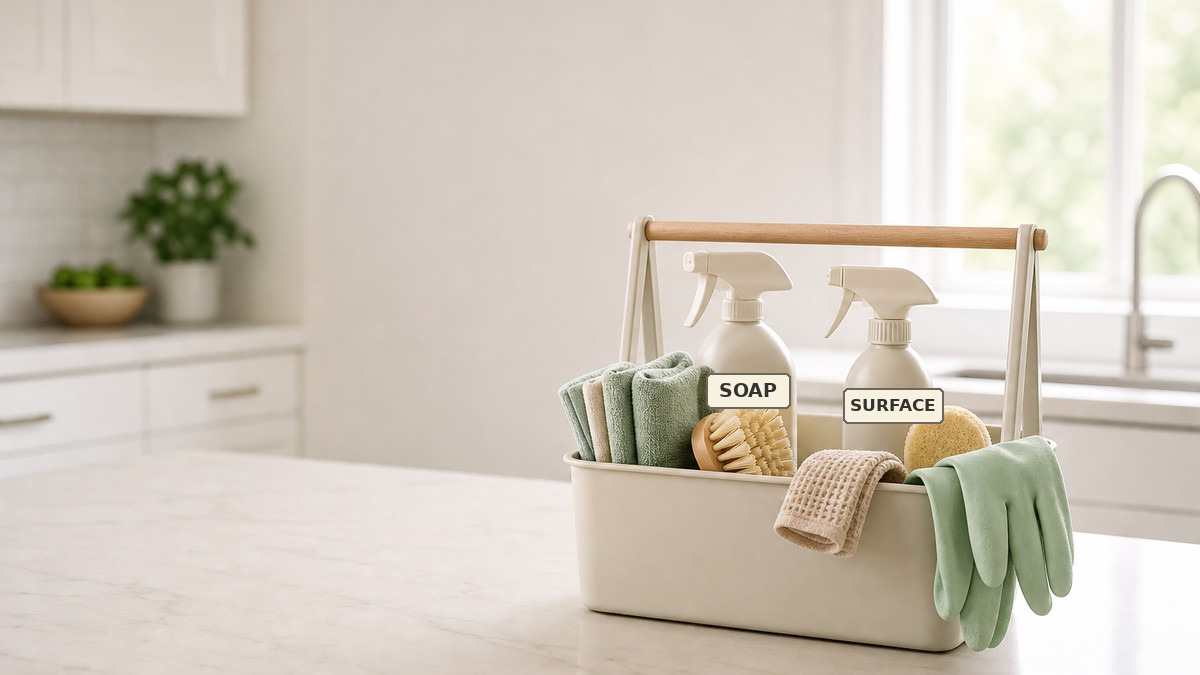
Cleaning Caddy Checklist for a Simple Budget Cleaning Kit
A cleaning caddy checklist should make cleaning faster, not turn your cabinet into a store shelf. Start with six items that handle most weekly jobs, then add room-specific products only when a surface actually needs them.
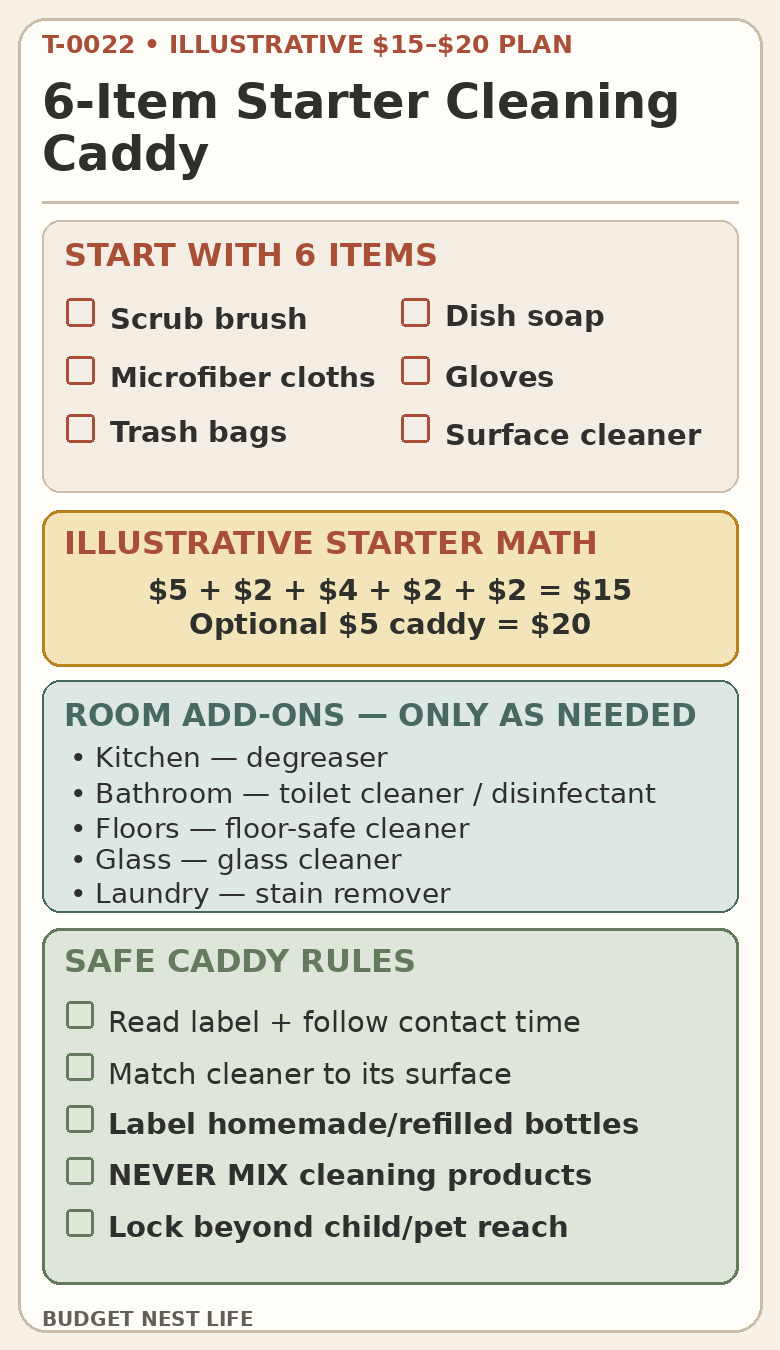
Start here: Build one starter caddy with a scrub brush, dish soap, microfiber cloths, gloves, trash bags, and one cleaner that is safe for your surfaces. Keep disinfectant separate for jobs that truly need disinfecting, and follow the label instead of mixing cleaners.
Cleaning Caddy Checklist: The 6-Item Starter Kit
| Item | Use It For | Approx. Starter Cost |
|---|---|---|
| microfiber cloths | counters, mirrors, dusting | illustrative $5 allocation |
| dish soap | greasy spots, many washable surfaces | illustrative $2 allocation |
| surface-safe cleaner | routine wipe-downs | illustrative $4 allocation |
| trash bags | quick room resets | use what you already buy |
| gloves | skin protection | illustrative $2 allocation |
| scrub brush | sinks, tubs, grout lines | illustrative $2 allocation |
Here is an illustrative starter plan, not a store-price survey: $5 cloths + $2 dish soap + $4 surface-safe cleaner + $2 gloves + $2 brush = $15, with a basket you already own and trash bags already in the home. Add a $5 caddy only if you need one, bringing this example to $20. More products aren’t better if they slow you down or create storage clutter.
Cleaning vs. Disinfecting
Routine cleaning and true disinfecting solve different problems. Cleaning removes dirt, crumbs, grease, and residue. Disinfecting uses a product labeled to kill specific germs and usually requires a contact time.
| Job | Usually Needs | Note |
|---|---|---|
| crumbs and dust | cloth or vacuum | clean first |
| greasy counter spot | dish soap and water | rinse if needed |
| bathroom sink | cleaner matched to surface | wipe and dry |
| illness cleanup | disinfectant | follow label contact time |
| glass or mirror | glass cleaner or safe mix | avoid screens/coated surfaces |
For a disinfectant, use an EPA-registered product and follow its label directions and contact time; see EPA guidance on registered disinfectants. The safest caddy is the one where each product has a clear job.
Room-by-Room Add-On Rule
Don’t add a product unless a room actually needs it.
| Room | Add Only If Needed | Skip If |
|---|---|---|
| kitchen | degreaser or stainless cleaner | dish soap handles the job |
| bathroom | toilet cleaner, disinfectant | routine wipe is enough |
| floors | floor-safe cleaner | you already have the right product |
| glass | glass cleaner | microfiber + safe mix works |
| laundry | stain remover | stains are rare in your home |
A budget cleaning kit grows by problem, not by aisle. If the same cleaning issue shows up three times, write down the item and its price from your own store before deciding whether the add-on earns a place.
$0 and Low-Cost Swaps
| Instead of Buying | Try First | What You Avoid Adding |
|---|---|---|
| new caddy | basket, handled tote, small bin | another container before testing the kit |
| paper towels | washable cloths or cut-up old towels | a separate disposable-cleaning purchase |
| specialty spray | dish soap and warm water where safe | a product without a clear surface job |
| extra scrub tools | one brush plus an old toothbrush | duplicate tools for the same task |
| separate room kits | one caddy plus one room add-on | duplicate bottles in several rooms |
This budget approach pairs well with vinegar cleaning solution recipes because homemade mixes still need labels, surface limits, and never-mix rules.
What Not to Put in a Cleaning Caddy
Some things are better stored separately.
- Unlabeled bottles.
- Products that should not be mixed.
- Bulky backstock refills.
- Medicine or personal care items.
- Anything that leaks when carried.
- Products that must be kept away from children or pets in a locked place.
If a cleaner has a special safety instruction, follow the label. The caddy is for access, not for ignoring storage rules.
A 15-Minute Caddy Cleaning Routine
Use this with a simple cleaning schedule.
- Put trash in one bag.
- Carry the caddy to one room only.
- Clear one visible surface.
- Wipe the surface with the right product.
- Scrub one sink, tub spot, or sticky area.
- Put used cloths in the laundry.
- Restock the caddy before putting it away.
The “one room only” rule matters. A cleaning caddy should keep you focused, not send you around the whole house.
Where to Store the Caddy
| Home Setup | Storage Idea |
|---|---|
| small apartment | under sink only if safe and dry |
| family home | high shelf or locked cabinet if needed |
| shared bathroom | labeled bin with personal products separate |
| tiny closet | narrow handled basket |
| laundry area | shelf near cloths and trash bags |
If you store it under a sink, check for kids, pets, leaks, and unlabeled bottles before choosing that spot. In a small apartment, pull the caddy out once a week and look for a damp cabinet floor or a bottle leaning against the drain pipe. If the space smells musty or the pipe drips, store the caddy on a higher shelf until the leak is fixed.
Surface Match Checklist
Before putting a product in the caddy, match it to the surfaces you actually clean.
| Surface | Safer First Choice | Check Before Using |
|---|---|---|
| laminate counter | dish soap and water or surface-safe spray | label directions |
| natural stone | stone-safe cleaner | avoid acidic cleaners like vinegar |
| glass | glass cleaner or approved mix | coated screens are different |
| tub or tile | bathroom-safe cleaner and brush | ventilation and label contact time |
| wood | wood-safe method | do not soak the surface |
This checklist prevents one cleaner from being used everywhere. A small caddy can still be specific if every bottle has a clear surface job.
One-Caddy Restock Budget
Keep the kit small by giving restocks a limit. Check once a month and buy only what is actually low, torn, or unsafe to keep using.
| Item | Restock When | Typical Budget Range |
|---|---|---|
| microfiber cloths | fewer than a week’s worth are clean and usable | use your dated price-book entry |
| dish soap | one bottle is nearly empty | use your dated price-book entry |
| surface-safe cleaner | current bottle has about one week left | use your dated price-book entry |
| gloves | torn, too small, or missing | use your dated price-book entry |
| trash bags | one roll remains | varies by household |
| scrub brush | bristles are flattened or dirty | use your dated price-book entry |
| disinfectant | label-required jobs are coming up | use your dated price-book entry |
One monthly check keeps the caddy stocked without a separate supply list. It prevents last-minute buying without turning the small starter kit into a backup closet.
Apartment and Small-Space Version
If storage is tight, use a half-size caddy.
| Keep in the Caddy | Store Elsewhere |
|---|---|
| 2 cloths | bulk cloth stack |
| one surface-safe cleaner | refill bottle |
| gloves | extra gloves |
| small brush | mop, broom, vacuum |
| trash bags for one room reset | full trash bag box |
A small-space caddy should be easy to carry with one hand. If it’s too heavy, it’ll stay in the cabinet.
Common Mistakes
Buying every “essential” cleaning product list
Most lists are too big for a small home. Start with six items and add only what your surfaces require.
Mixing cleaning products
Do not mix products. A budget cleaning routine is not worth unsafe fumes or damaged surfaces.
Forgetting labels
If a product is homemade or moved to another bottle, label it with the mix, date, and surface limits.
Letting the caddy become storage
The caddy should carry current-use items. Backstock refills belong in a separate labeled area.
Label Template for Homemade or Refilled Bottles
If you refill or mix a bottle, label it before it goes in the caddy.
Name: __________
Mixed on: ______
Use on: ________
Do not use on: __
Never mix with: _
This is especially important for vinegar mixes, diluted products, or any bottle that no longer has the original label. A clean home isn’t worth guessing what is inside a spray bottle.
FAQ
What should be in a basic cleaning caddy?
Start with a scrub brush, dish soap, microfiber cloths, gloves, trash bags, and one cleaner that is safe for your surfaces. Add disinfectant or room-specific products only when the job requires them.
Do I need a separate cleaning caddy for every room?
No. One starter caddy plus a few room add-ons is enough for many homes. Separate kits can create duplicate bottles and more storage work.
Should vinegar be in a cleaning caddy?
It can be, if it’s labeled and used only on safe surfaces. Do not use vinegar on natural stone, and never mix it with bleach.
Where should I store cleaning products if I have kids or pets?
Use a locked or out-of-reach location and follow product labels. Don’t rely on a low under-sink cabinet if children or pets can access it.
Final Takeaway
A cleaning caddy checklist should keep weekly cleaning simple: six starter items, one room at a time, and add-ons only when a real surface or safety need appears.