
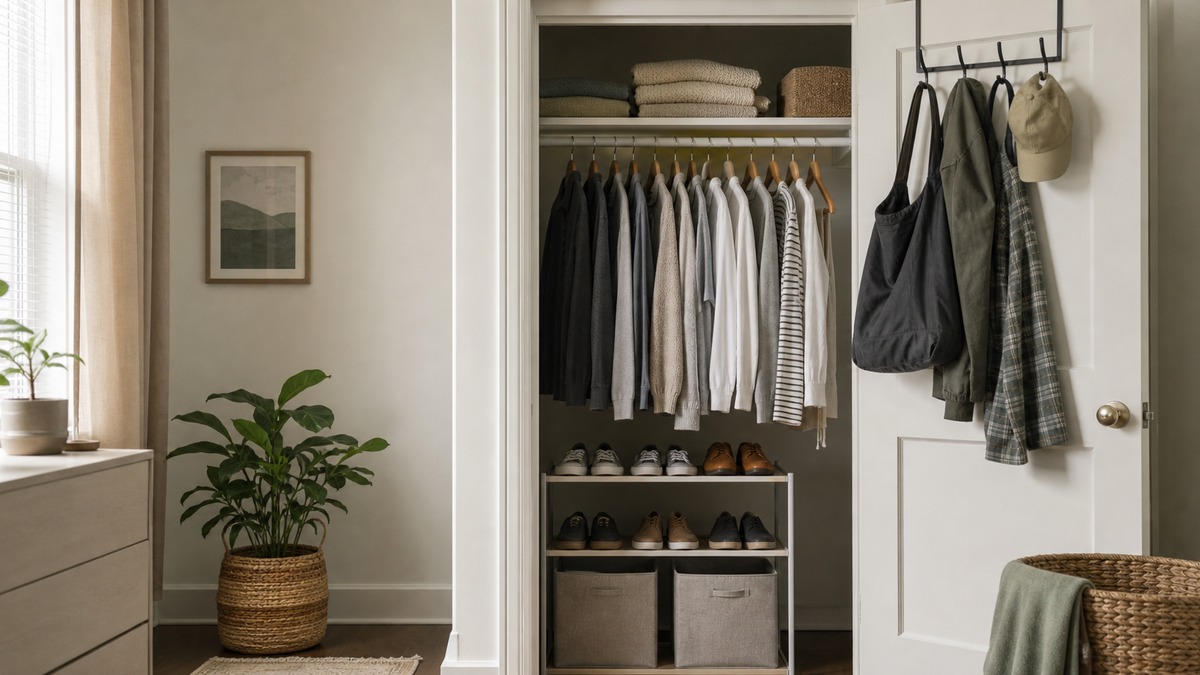
If your closet is packed but you still can’t find a clean work shirt, start with the space you already own before buying a system. This small closet organization on a budget plan uses a 15-minute floor reset, a $0 sort, and only under-$25 or under-$100 upgrades when the same problem keeps coming back.
Fast win: Set a 15-minute timer and clear the closet floor first. Put shoes in one row, place laundry in a hamper, and move anything that belongs in another room to a tote or bag by the door. Spend $0 today; buy only after you know which pile returns by the end of the week.
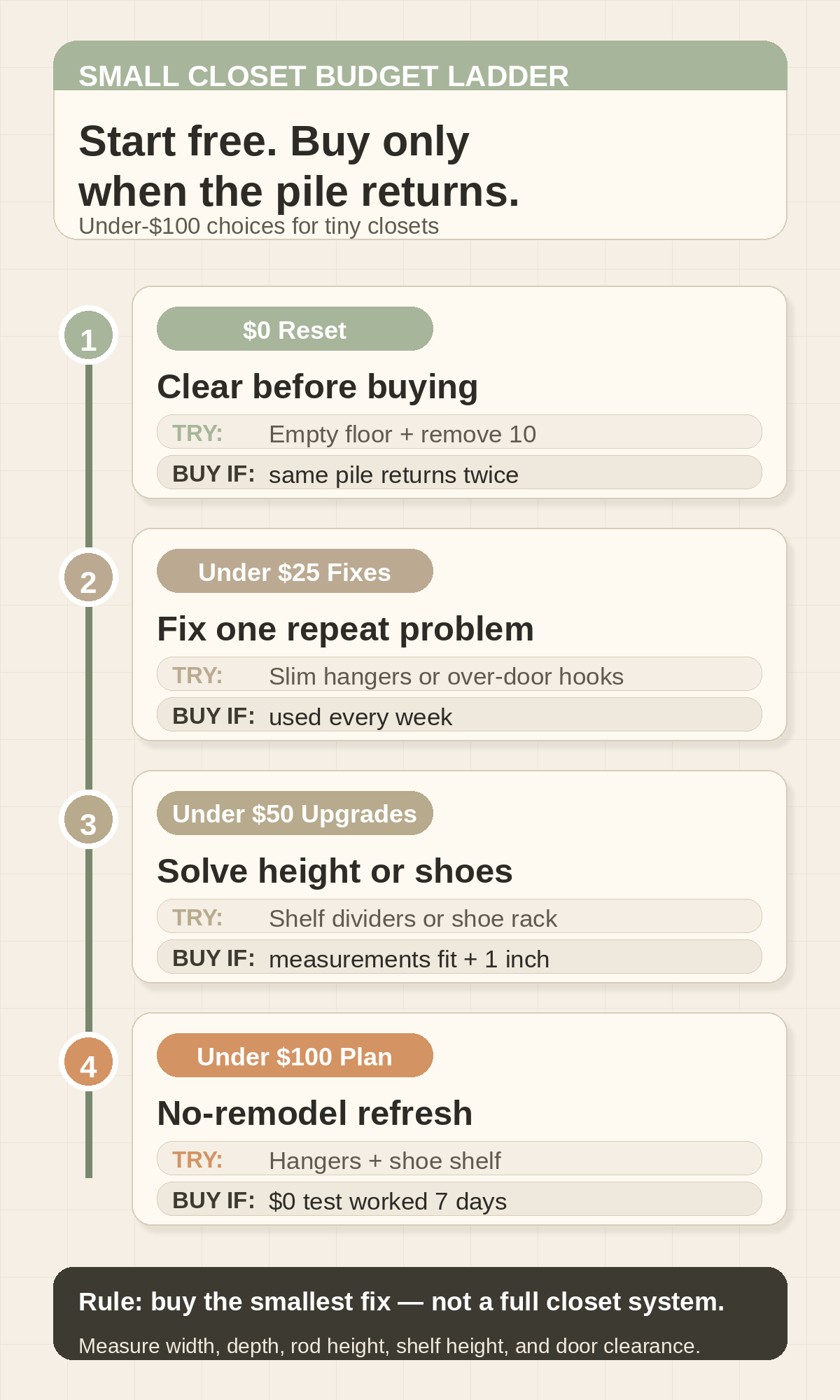
Small Closet Budget Ladder
| Budget level | Use it for | What to try first | Buy only if |
|---|---|---|---|
| $0 | clutter, duplicates, off-season bulk | empty the floor, remove 10 items, fold sweaters higher | the same pile returns twice |
| Under $25 | one repeat problem | slim hangers, over-door hooks, one shelf bin from Target, Walmart, or Dollar Tree | the item gets used weekly |
| Under $50 | lost shelf height or messy shoes | shelf dividers, a small shoe rack, two clear bins | measurements fit with 1 inch to spare |
| Under $100 | no-remodel closet refresh | hangers + shoe shelf + over-door organizer + 2 bins | you tested the $0 reset for 7 days |
Pull 10 items before you buy bins
A small closet usually feels impossible because it holds several jobs at once: current clothes, next season’s clothes, repair items, gifts, and things that never belonged in a closet. Do not empty the whole closet if you only have 20 minutes. Pull 10 items first.
Use this quick pass: two laundry or repair items, two off-season items, two pieces that do not fit this month, two items from another room, and two pieces you keep skipping. Place them into three bags: wash, store, and decide. The decide bag gets one week before donation, resale, textile recycling, or trash if the item is no longer usable.
Use the 15-Minute Measurement Card
Cheap storage wastes money when it does not fit. Measure before buying hangers, bins, hooks, or a shoe rack.
| Measurement | Write down | Why it matters |
|---|---|---|
| Closet width | ___ inches | shows if a shoe shelf or second rod can fit |
| Closet depth | ___ inches | keeps bins from blocking sliding doors |
| Rod height | ___ inches | tells you what can sit below hanging clothes |
| Shelf height | ___ inches | decides if dividers or stacked bins make sense |
| Door clearance | ___ inches | checks whether over-door hooks will close cleanly |
Keep the numbers in your phone. They help at Target, Walmart, IKEA, Dollar Tree, or a thrift store because packaging often looks smaller in the aisle. If your closet has sliding doors, measure the actual opening too. Leave about 1 inch of breathing room around anything that slides, lifts, or hangs over a door.
Build the $0 reset first
The $0 version is the test that shows what you actually need. Most small closets have at least one free fix hiding in plain sight.
Try these before shopping:
- Move off-season coats, heavy sweaters, or formal clothes to a higher shelf, under-bed bin, or spare suitcase.
- Hang only current-season clothes at eye level.
- Fold bulky sweaters instead of hanging them, especially if they stretch on hangers.
- Use a shoebox lid as a temporary tray for belts, lint rollers, sunglasses, or small accessories.
- Turn one sturdy shopping bag into the donation bag and keep it near the door.
- Use mixed hangers if you already own them. Too many clothes are a bigger problem than mismatched hangers.
Example: a renter in a 650-square-foot apartment can fold workout clothes into two open shelf bins, move winter boots under the bed, and keep only five pairs of shoes on the closet floor. That may fix weekday mess for $0. If the bins are hard to reach after a week, then one under-$25 shelf bin may be worth it.
Spend under $25 on the pile that returns
Under-$25 fixes work best when they solve one specific annoyance. Pick the spot that steals time every morning.
| Repeat problem | Under-$25 fix | Store anchor | Skip if |
|---|---|---|---|
| Shoes cover the floor | one small shoe rack or boot tray | Walmart, Target, IKEA, thrift store | you own more shoes than the rack can hold |
| Belts and scarves disappear | over-door hooks or adhesive hooks within package limits | Dollar Tree, Target, Walmart | the door will not close cleanly |
| Sweaters collapse | one shelf divider or a repurposed box | Target, IKEA, owned box | the shelf is too shallow |
| Small items scatter | one open bin, not a deep lidded tub | Dollar Tree, Walmart | you need the item every day |
| Hangers jam together | slim hangers for current-season items only | Target, Walmart, Costco pack | clothes are not decluttered yet |
Approximate prices move around, but a basic hook set, one shelf bin, or a small pack of slim hangers often fits this tier. If closet shopping turns into a browse through candles, decor, and extra baskets, use the pause habit from things to stop buying to save money: leave the item in the cart for 24 hours and check whether it solves a named closet problem.
Use under $50 for height, shoes, or sharing
A $50 closet budget can do more if you avoid pretty extras and focus on wasted vertical space. Choose one combination: shelf dividers plus one open bin, a two-tier shoe rack plus a boot tray, slim hangers plus over-door hooks, or two clear bins for off-season clothes if the shelf is deep enough.
For a shared closet, split the space by behavior. One person may need more hanging space for work clothes; another may need one gym-clothes bin. The zone approach pairs with small apartment entryway organization.
Put under $100 into a no-remodel setup
An under-$100 plan is enough for a no-remodel closet refresh when you do not need custom shelving.
| Item | Approx. budget role | What it fixes |
|---|---|---|
| Slim hanger pack | about $10-$25 | crowded rod, uneven hangers |
| Two open shelf bins | about $10-$25 | folded clothes, workout gear, small bags |
| Small shoe shelf | about $15-$35 | floor pile, blocked walkway |
| Over-door organizer or hooks | about $10-$30 | scarves, belts, hats, lightweight accessories |
That mix can stay around $50-$100 depending on the store and what you already own. Use the measurement card before buying, and keep receipts until the closet survives one normal laundry cycle.
Avoid tall, freestanding storage unless you can install it according to the manufacturer’s directions and it does not wobble. If you rent, check the lease before drilling or adding permanent hardware.
Renter-friendly small closet ideas
Renters need fixes that come down cleanly. Choose no-drill and easy-remove options first: over-door hooks for lightweight accessories, a freestanding shoe rack that does not block the door track, shelf bins with removable labels, and under-bed storage for off-season clothes.
Adhesive hooks can help with belts, hats, or necklaces, but they are not for heavy bags or anything breakable. Stay within the package weight limit, test one first, and use over-door options if paint is old or peeling. If you move often, choose bins and racks that can work in a pantry, laundry closet, or entryway later. The same open-bin logic from how to organize a small pantry works here.
Problem-to-cheapest-fix table
| Closet problem | Cheapest first fix | When to upgrade | What not to buy first |
|---|---|---|---|
| You rebuy basics because you cannot see them | group socks, tees, or leggings in one open bin | add a second bin only if the first stays useful | lidded tubs for daily clothes |
| Shoes block the floor | keep only current-week pairs in the closet | add a shoe rack after 7 days | a large shoe cabinet that blocks doors |
| Hanging clothes are packed tight | remove 10 skipped items and switch seasons | buy slim hangers for keepers | more hangers before decluttering |
| Shelf stacks fall over | fold by category and use one divider | add matching dividers later | deep baskets above eye level |
Use this table before any shopping trip. The cheapest fix should match the exact failure. If the failure is “I own too many maybes,” a $40 bin will only hide the maybes.
Helpful source
If your closet cleanout creates bags of clothing, shoes, or textiles, do not let them sit in the hallway for a month. The EPA tracks textiles as part of municipal solid waste, and its EPA textiles data is a useful reminder to choose a real next step: donate usable items, use local textile recycling where available, or discard items your donation center will not accept.
FAQ
How do I organize a small closet on a budget first?
Clear the floor, pull 10 items, and measure the closet before buying anything. If you have only 15 minutes, focus on shoes, laundry, and items that belong in another room. That gives you the fastest space back for $0.
What should I buy first for a small closet?
Buy the item that fixes the pile that returned after a 7-day reset. That might be a small shoe rack, one open shelf bin, over-door hooks, or slim hangers for clothes you actually wear. Do not buy a full system before you know your measurements.
How can renters organize a small closet without drilling?
Use over-door hooks, shelf bins, a freestanding shoe rack, under-bed storage, and removable labels. Check weight limits on adhesive products and avoid heavy hanging items if the wall or door finish is questionable.
Are closet organizers worth it for a tiny closet?
They are worth it when they solve a measured problem. A $20 shoe rack can help if shoes block the floor. A $90 mix of hangers, bins, and hooks can be wasteful if the closet still holds off-season clothes, repair items, and donations.
One closet rule to keep
Buy the smallest fix for the named pile. If the pile is shoes, fix shoes. If the pile is laundry, fix the hamper spot. If the pile is guilt clothes, no organizer will beat a donation bag with a real drop-off date.