
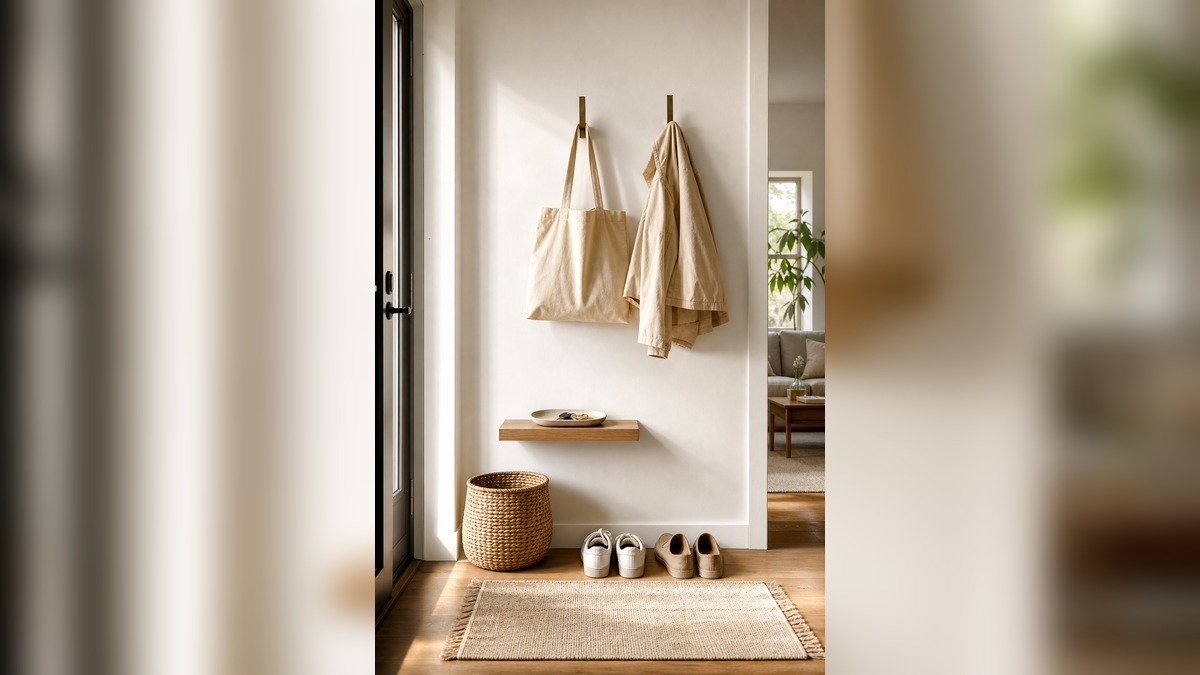
A small apartment entryway has to work hard. It may be only a wall, a corner, or the first three feet inside the door, but it still needs to hold shoes, keys, bags, mail, coats, and whatever you drop when you walk in.
The best small apartment entryway organization starts with one question: what lands here every day? Once you know that, you can build a simple landing zone without buying bulky furniture.
Start With a 10-Minute Entryway Reset
Before you buy anything, empty the entryway and sort what is there.
Use four piles:
- Keep here daily
- Move to another room
- Donate or toss
- Needs a home
Most entryways feel too small because they are holding too many categories. The goal is not to store everything by the door. The goal is to store only what helps you leave and come home smoothly.
Small Apartment Entryway Organization Formula
A functional entryway needs four zones:
- A spot for shoes
- A hook or rail for bags and coats
- A small place for keys and wallet
- A mail or paper control system
If you can solve those four, the entryway will feel dramatically calmer. A small entryway can work with just four zones: shoes, hooks, keys, and paper control.
Apartment Therapy’s small entryway examples also show that slim furniture, wall hooks, and narrow shoe cabinets are common solutions when floor space is limited: small entryway organization ideas.
1. Use Vertical Space First
When floor space is limited, the wall is your storage. Add hooks before adding furniture.
Good vertical options:
- Adhesive hooks for renters
- Over-the-door hooks
- A slim wall rail
- Peg hooks
- A small wall shelf with hooks underneath
Use hooks for the items you actually grab daily: one bag, one jacket, keys, dog leash, or reusable grocery bag. Do not let every coat in the house live at the front door.
2. Limit Shoes to One Pair Per Person
Shoes can take over a tiny entryway faster than anything else.
Try this rule:
| Household Size | Entryway Shoe Limit |
|---|---|
| 1 person | 2 pairs max |
| 2 people | 3–4 pairs max |
| Family | 1 daily pair per person |
Move extra shoes to a closet, under-bed bin, or bedroom storage. The entryway is for daily rotation, not the entire shoe collection.
3. Pick a Shoe Solution That Matches Your Space
Do not buy a shoe bench if you only have wall space. Match the organizer to the actual shape of your entry.
If you have a narrow hallway
Use a slim shoe cabinet or vertical shoe rack.
If you have only a door
Use an over-the-door shoe organizer or hooks for bags.
If you have a tiny corner
Use a two-tier shoe rack with a basket on top.
If you have no entryway at all
Create a landing zone on the nearest wall with hooks and a small tray.
4. Create a Key Drop Zone
Keys need one home. Not three possible homes. One.
Easy options:
- A small bowl on a shelf
- A wall-mounted key hook
- A tray on a narrow table
- A magnetic strip if it fits your style
Put the key zone where your hand naturally goes when you enter. If you have to walk across the room, you probably will not use it.
5. Stop Mail at the Door
Mail clutter is usually decision clutter. Give paper a simple system.
Use three categories:
- Action: bills, forms, appointments
- File: documents to keep
- Recycle: ads and envelopes
Keep only the “Action” category in the entryway. Recycle junk mail immediately. Move filing papers once or twice a week.
6. Add a Small Basket for Daily Carry Items
A basket can hold the things that otherwise scatter across the floor.
Use it for:
- Sunglasses
- Gloves
- Dog leash
- Reusable bags
- Umbrella
- Small seasonal items
Keep the basket small. A large basket becomes a clutter cave.
7. Use a Mirror to Make the Entry Feel Bigger
A mirror is not storage, but it helps a small entryway feel more open. It also gives you a last check before leaving.
Choose a lightweight mirror if you are renting. Use renter-friendly hanging methods only if they are safe for the mirror weight.
8. Keep Decor Flat and Functional
In a small entry, decor should not steal storage space.
Better choices:
- A washable mat
- One small framed print
- A mirror
- A pretty tray
- Matching hooks
Avoid oversized vases, floor baskets that block the door, or decor that makes it harder to put things away.
9. Build a Budget Entryway With What You Already Have
You may not need a new organizer. Try repurposing first.
Look for:
- A small tray from the kitchen
- A basket from a closet
- Command-style hooks already in a drawer
- A spare shelf
- A small bin from under the sink
- A shoe rack from another room
Measure before buying anything. In a small apartment, one inch can decide whether the door opens fully.
10. Use the Door Swing Test
Before placing furniture, open the front door all the way. Then mark the space the door needs.
Use this mini measurement check before buying anything:
- Door opens fully without hitting storage.
- Walkway stays at least one body-width clear.
- Shoes do not sit in the door swing.
- Hooks are reachable without blocking a light switch.
- The organizer is shallow enough for daily traffic.
Do not put storage where it blocks:
- The door swing
- A closet door
- A walkway
- A light switch
- A thermostat
A slightly smaller organizer that does not block movement is better than a pretty one that annoys you every day.
11. Make a 60-Second Reset Routine
Organization only works if it is easy to reset.
At night or after work:
- Put shoes back on the rack.
- Hang the bag or coat.
- Put keys in the tray.
- Recycle junk mail.
- Move anything that belongs in another room.
This should take less than one minute. If it takes longer, your system has too many steps.
Budget-Friendly Entryway Shopping List
If you do need to buy something, start small.
| Item | Budget Range | Why It Helps |
|---|---|---|
| Adhesive hooks | $5–$12 | Uses wall space without drilling |
| Small tray | $3–$10 | Creates a key and wallet zone |
| Two-tier shoe rack | $10–$25 | Controls daily shoes |
| Slim basket | $5–$15 | Holds leash, gloves, or bags |
| Washable mat | $10–$25 | Keeps dirt from spreading |
Buy only what solves a specific problem. Do not buy a full matching system until you know what your entryway actually needs.
FAQ
How do you organize an entryway with no closet?
Use wall hooks for coats and bags, a small shoe rack for daily shoes, and a tray or shelf for keys. Keep seasonal or extra items in another room.
What should be stored in a small apartment entryway?
Store only daily-use items: keys, wallet, one bag, daily shoes, coat, mail that needs action, and small grab-and-go items.
How do I keep shoes from cluttering the entryway?
Set a one-pair-per-person rule and move extra shoes to a closet or bedroom storage. Use a small rack or cabinet only for daily shoes.
What is the cheapest way to organize an entryway?
Start with decluttering, then use items you already own: a tray, basket, hooks, and a small mat. Buy only after measuring the space.
Related Home and Budget Ideas
If entryway clutter is tied to impulse home purchases, try a [no spend challenge](/no-spend-challenge-rules/) before buying more baskets. If annual home replacements keep surprising your budget, set up a [sinking fund category](/sinking-funds-categories-list/) for household items.
Final Takeaway
Small apartment entryway organization works best when it is simple. Use vertical space, limit shoes, create one key zone, control mail, and keep only daily items near the door. A tiny entry does not need more stuff. It needs fewer decisions.