
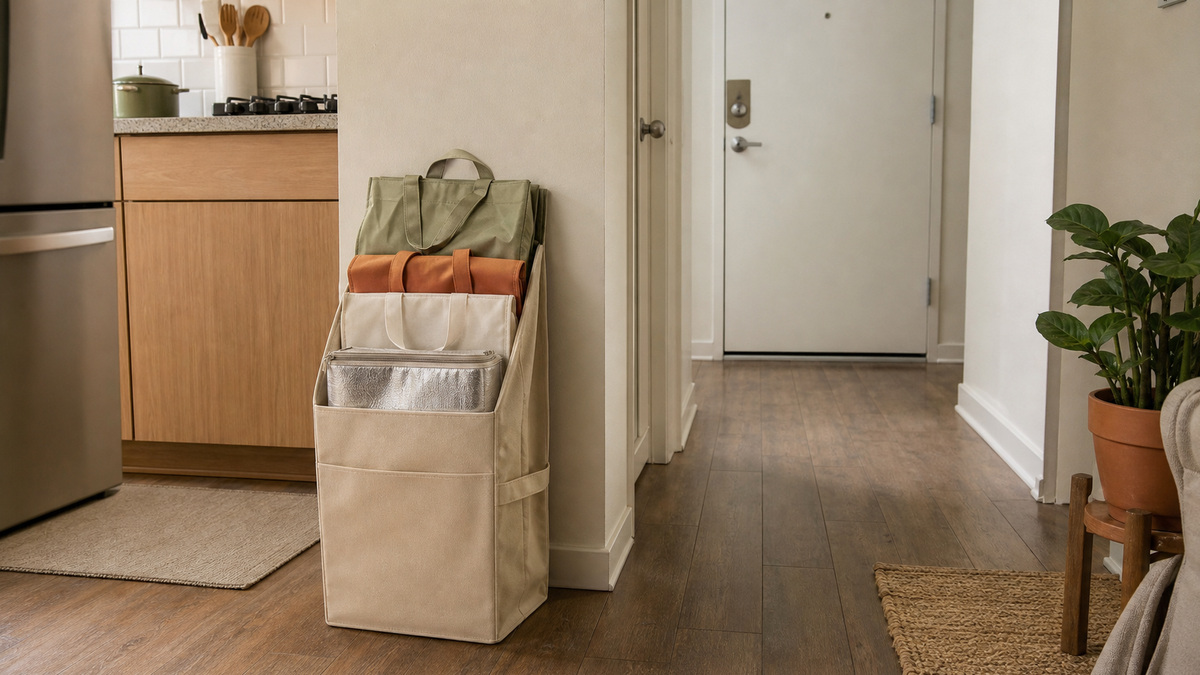
By the next grocery run, the bags now stranded in your crowded kitchen cabinet can be waiting on the route from your one-bedroom apartment to the car. These reusable grocery bag storage ideas give you seven spots to compare, one active trip roster, and a simple return loop.
Quick answer: Use Unload → Reset → Return after each trip. First, keep bags for the weekly trip, a quick top-up, and cold items when needed; give them one home on the way out. Skip a spot that adds a detour or blocks the door. Stop when the carrier or slot closes without stuffing.
7 Reusable Grocery Bag Storage Ideas by Route
| Storage spot | Best route + stop rule |
|---|---|
| 1. Car-trunk carrier | Driver’s route; stop when one carrier closes easily. |
| 2. Entryway or coat-closet hook | Door route; stop at one uncrowded bundle. |
| 3. Largest tote near the exit | No-closet route; stop before it bulges or blocks the path. |
| 4. Narrow kitchen-cabinet slot | Kitchen-to-exit route; stop when bags no longer slide out alone. |
| 5. Drawer with upright bags | Near-door drawer route; stop before the drawer jams. |
| 6. Compatible over-door or closet-rod holder | Approved exit-side route; stay within the stated load. |
| 7. Everyday tote or backpack pocket | Walking or transit route; stop at one compact spare. |
- Car-trunk carrier: Use stiff totes or nested soft bags. Return the full bundle after unloading. Skip it if the car isn’t your normal route or care directions rule it out.
- Entryway or coat-closet hook: Use light handled totes. Hang the nested bundle after the kitchen reset. Skip it if handles crowd coats, the door, or the walking path.
- Largest tote near the exit: Nest mixed soft bags inside. Return the tote after each trip. Skip it if it becomes a catchall or enters the walkway.
- Narrow kitchen-cabinet slot: File dry, flat-fold totes upright. Return them after unloading. Skip a slot that is damp, crowded, or off the exit route.
- Drawer with upright bags: Fold and file compact totes. Return each dry bag to the drawer. Skip it if the drawer jams or hides an insulated bag.
- Compatible over-door or closet-rod holder: Use light soft totes. Return one nested bundle. Skip it if the lease, door fit, hardware load, or product directions don’t allow it.
- Everyday tote or backpack pocket: Refold one compact spare into the same pocket. Skip it if it crowds keys, a wallet, or daily gear.
Choose one primary spot, not seven organizers. A trunk carrier can hold the active set, while one compact spare rides in the everyday tote. For the exit area, use these small apartment entryway organization ideas without rebuilding the shoe, key, and mail zones.
Build the Trip-Type Bag Roster Before You Fold Anything
The Trip-Type Bag Roster separates daily needs from occasional capacity. Your cart, transportation, and bag shapes decide the count.
| Trip type | Bag job + home + trigger |
|---|---|
| Normal weekly trip | Carry the usual load. Keep it in the primary spot. Replace it if its load, condition, or care directions no longer fit. |
| Quick top-up | Carry fill-in items. Nest it with the primary set. Remove it if another active bag does the same job. |
| Cold or frozen trip | Use an insulated bag when regularly needed. Close-store it only when ready. Remove it if the closure, lining, or condition fails its job. |
| Compact emergency spare | Cover one unplanned stop. Keep it in the everyday pocket. Remove it if it won’t refold or crowds daily items. |
| Occasional warehouse trip | Add rare extra capacity. Store it in the largest exit-side tote. Move it out if it crowds the active carrier. |
Use an existing tote, hook, drawer, or open slot before shopping for a holder. In this one-bedroom apartment, the handoff matters more than a new product. Stop when the set covers weekly, top-up, and regular cold-item trips and its home closes without force.
A pantry inventory checklist can shape the shopping list; this roster handles only the bags that leave with it.
Run the Unload-to-Return Loop After Every Grocery Trip
The Unload-to-Return Loop has three stages, so the trip doesn’t quietly end with empty bags on the kitchen floor.
- Unload: Empty every bag. Separate any insulated, damp, or visibly soiled bag so it isn’t closed inside the clean bundle.
- Reset: Fold or nest only dry, active bags in a way that suits their material and shape. Follow each bag’s care directions rather than applying one wash or fold rule to everything.
- Return: Move the carrier to the chosen departure spot before putting away the last unrelated kitchen item.
That three-stage route is Unload → Reset → Return. If bags stop in the kitchen twice, don’t add an organizer. Move their home onto the kitchen-to-exit path: the cabinet slot, largest tote, or entryway hook.
Match the Fold to 4 Bag Types
Soft totes can usually lie flat or nest inside a larger tote. Stiff box bags need enough width to keep their shape, so forcing them into a narrow drawer creates a poor fit. Compact pouch bags return to their own pouch or everyday pocket when the design allows it.
Treat insulated bags separately. Empty them, follow the maker’s care information, and keep them out of closed storage while damp or visibly soiled. No single fold, wash schedule, or closed container works for every material.
Use this quick match before returning a bag:
- Soft foldable tote: flatten handles and nest with similar bags.
- Stiff box bag: keep upright in the trunk carrier or largest tote.
- Insulated bag: close-store only when its condition and care directions allow.
- Compact pouch bag: refold into its pouch or assigned everyday pocket.
Use the 7 Spots Without Adding a Detour
For the one-car renter, start with spot 1: place an existing carrier in the trunk and bring it into the apartment after shopping. Return it only after Unload and Reset are complete.
Spot 2 works when a coat-closet hook is on the exit path and the bundle stays light. Spot 3 places the largest tote beside the exit but outside the walking and door-swing area. Spot 4 works only if the kitchen slot is closer to the exit than the crowded shelf.
Spot 5 keeps compact bags upright and visible. Spot 6 works only when the lease, door fit, hardware load, and product directions allow it. Spot 7 holds one compact spare in the tote or backpack that leaves home.
A price-tracking task shouldn’t enter this storage zone. If store comparison is part of grocery day, keep it in a separate grocery price book template rather than tucking receipts and notes into the bag carrier.
What Changes Without a Car, Garage, or Entryway Closet
No car: End the loop at spot 2 or spot 7. A light bundle can hang at the departure hook, while one compact spare stays in the everyday tote used for walking or transit.
No entryway closet: Use spot 3 beside the exit or spot 4 on the kitchen-to-door line. Don’t place the largest tote where it narrows the walkway, and don’t sacrifice a cabinet slot that needs to hold food or cookware.
Damp, soiled, or insulated bag: Pause before Reset. Keep it separate from the clean bundle until its condition and individual care directions allow closed storage.
Occasional warehouse trip: Keep that extra capacity in spot 3, outside the daily bundle. Bring it into the active carrier only for the larger trip, then return it to occasional status.
Know When the Bag Zone Is Full Enough
Use two stop tests. First, the carrier, drawer, pocket, or slot must close and release a bag without stuffing. Second, the set must cover each trip in the roster. Extra bags stay outside the active zone once both tests pass.
Offer clean, usable extras to someone who wants them. The EPA suggestions for reducing plastic waste include bringing reusable bags. They don’t set one lifespan, cleaning rule, or disposal route for every bag.
FAQ
How do I store reusable grocery bags neatly in a small space?
Choose one of the seven spots on your actual route to the store, then keep only the bags assigned to weekly, top-up, cold-item, or compact-spare functions. Stop adding bags when the drawer, carrier, tote, or pocket no longer closes without stuffing.
Where is the best place to store reusable grocery bags so I remember them?
Use the spot you pass at departure: a trunk carrier for a regular driver, an entryway hook or largest tote near the exit, or an everyday pocket for walking and transit. If bags stall in the kitchen for two trips, move their home onto that kitchen-to-exit path.
How many reusable grocery bags should I keep?
There isn’t one correct number for every household. Keep an active roster that covers your normal weekly trip, quick top-up, any regularly used cold-item need, and one compact spare; store unusual warehouse-trip capacity outside the daily bundle.
Can reusable grocery bags be stored in the car?
A trunk carrier can work when the car is the regular departure route and the individual bags’ care directions and condition allow it. Don’t treat the car as a universal fit for every material, and remove any damp, visibly soiled, or care-sensitive bag from the closed bundle.
Final Takeaway: Finish the Grocery Trip at the Exit
On the next grocery day, carry the full bag bundle back from the kitchen to its chosen departure point. When that spot covers the Trip-Type Bag Roster and closes without stuffing, the seven-option search is finished and the stranded kitchen pile has a return route.