
Grocery Price Book Template for Tracking Real Food Prices
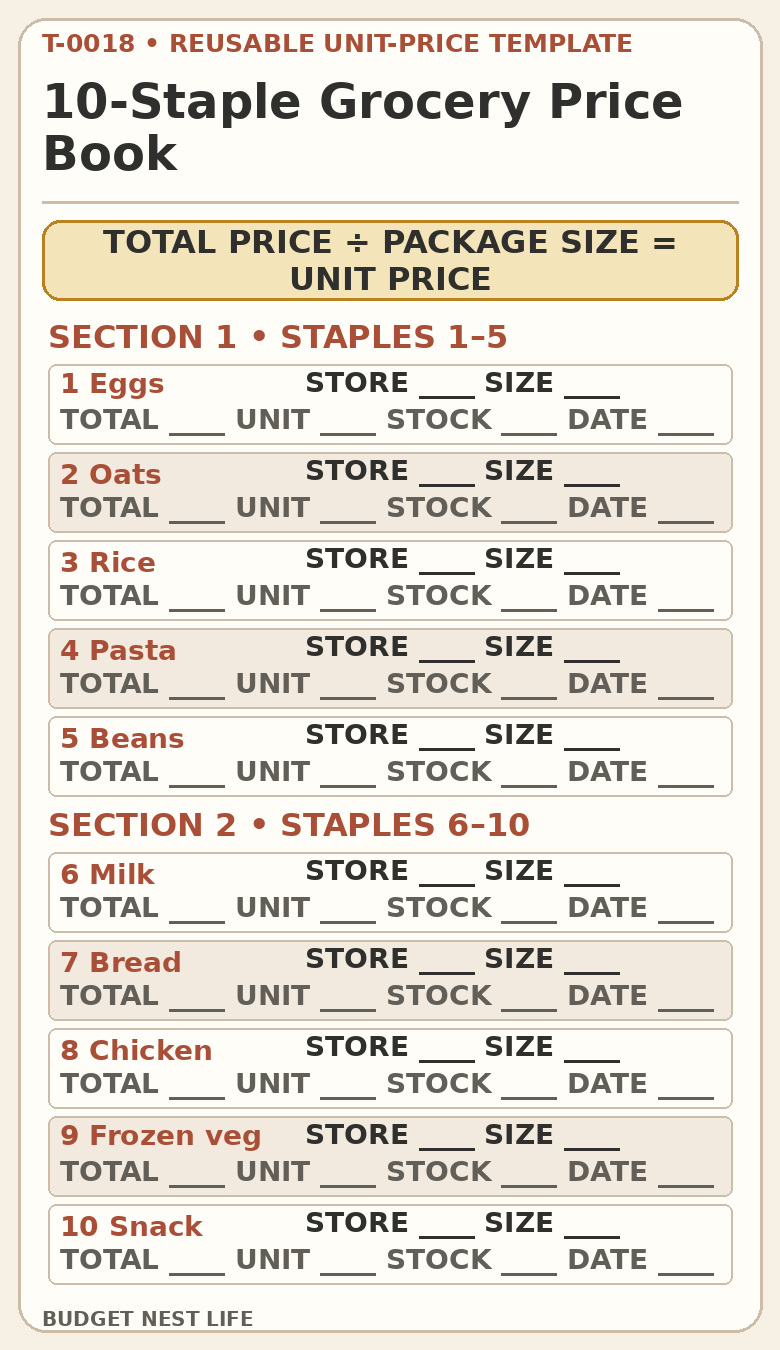
A grocery price book template helps you stop guessing which store is actually cheaper. Track the unit price for 10 repeat staples, mark your stock-up price, and update the list only when you shop those items.
Quick answer: Start with 10 foods you buy every month, such as eggs, oats, rice, pasta, chicken, milk, yogurt, beans, frozen vegetables, and bread. Record store, package size, price, unit price, and stock-up price. In the illustrative rice example below, $6.48 ÷ 80 ounces is about $0.08 per ounce; the unit price, not the shelf tag alone, is the comparison.
Grocery Price Book Template Fields
The dollar figures in this template example are illustrative practice entries, not current store observations. Replace them with the price and date from your own receipt or shelf tag.
| Field | Example | Why It Matters |
|---|---|---|
| Item | old-fashioned oats | keeps staples consistent |
| Store | Aldi | shows the best repeat stop |
| Package size | 42 oz | prevents price confusion |
| Total price | $4.29 | what you pay today |
| Unit price | $0.10/oz | the real comparison |
| Stock-up price | $0.08/oz | tells you when to buy extra |
| Date checked | the date you checked | shows when to refresh the entry |
This template is useful because it tracks repeat decisions, not every single grocery item. A price book that tries to track 200 foods usually gets abandoned.
The 10-Staple Starter List
Choose foods that appear in your cart again and again.
| Category | Starter Item | Track Unit |
|---|---|---|
| breakfast | oats, eggs, yogurt | ounce, egg, cup |
| pantry carbs | rice, pasta, tortillas | ounce or serving |
| proteins | chicken thighs, beans, tuna | pound, can, ounce |
| produce | apples, carrots, onions | pound or each |
| freezer | frozen vegetables | ounce |
| basics | milk, bread | gallon, loaf, ounce |
If your household rarely buys yogurt, skip it. A grocery price book should match your real cart, not a perfect budgeting spreadsheet.
How to Calculate Unit Price
Use the simple formula:
Total price ÷ package size = unit price
The prices in the next examples are illustrative numbers for practicing the formula. They are not current store observations or a price survey; enter the price and date from your own receipt or shelf tag.
| Item | Total Price | Package Size | Unit Price |
|---|---|---|---|
| rice | $6.48 | 80 oz | $0.08/oz |
| pasta | $1.24 | 16 oz | $0.08/oz |
| oats | $4.29 | 42 oz | $0.10/oz |
| chicken | $8.40 | 3 lb | $2.80/lb |
The package with the lower total price is not always the better deal. Unit price protects you from paying more for a smaller package.
Illustrative 3-Store Unit Price Tracker
Use this table when you shop at more than one store.
| Item | Walmart | Aldi | Costco/Target | Best Regular Buy | Stock-Up Price |
|---|---|---|---|---|---|
| oats | $0.11/oz | $0.10/oz | $0.08/oz | Costco/Target | $0.08/oz |
| eggs | $0.28/egg | $0.24/egg | $0.30/egg | Aldi | $0.22/egg |
| rice | $0.09/oz | $0.07/oz | $0.08/oz | Aldi | $0.07/oz |
| frozen veg | $0.10/oz | $0.09/oz | $0.08/oz | Costco/Target | $0.08/oz |
Do not drive across town to save 40 cents. Use the tracker to shape normal shopping, stock-up decisions, and your cheap grocery list for two weeks.
The Stock-Up Price Column
A stock-up price is the number that tells you, “buy one extra if the budget allows.” It stops you from buying extra just because a tag says sale. The numbers in this practice table are illustrative targets, not current prices.
| Item | Normal Price | Stock-Up Price | Buy Extra? |
|---|---|---|---|
| pasta | $1.49 | $0.99 | yes, if pantry space is open |
| chicken thighs | $2.99/lb | $1.99/lb | yes, if freezer space exists |
| cereal | $4.50 | $2.75 | maybe, if it is a regular item |
| snack crackers | $3.99 | $2.99 | only if snack budget allows |
Stocking up is only smart when the item gets used, the space exists, and the extra purchase does not break another budget category. This connects with grocery budget categories because the stock-up money needs a place in the budget.
What Not to Track
Skip items that change too often or do not matter enough.
- One-time holiday ingredients.
- Produce you buy only when it looks good.
- Treats that are not a regular staple.
- Items where brand preference matters more than price.
- Anything you will not update after two trips.
A small price book you update is better than a beautiful spreadsheet you ignore.
Weekly 5-Minute Price Book Routine
- Pick 3 to 5 items from the receipt.
- Add store, size, price, and date.
- Calculate the unit price.
- Mark whether it beats your stock-up price.
- Update the “best regular buy” column only if the difference is meaningful.
Meaningful usually means the savings repeat. If one store is 2 cents cheaper on one item but requires an extra trip, the savings may not be worth the time or gas.
Paper, Spreadsheet, or Phone Note?
Use the format you will update at the store or right after unloading groceries.
| Format | Best For | Watch-Out |
|---|---|---|
| paper notebook | quick receipt updates | easy to forget at home |
| spreadsheet | comparing stores and unit prices | can become too detailed |
| phone note | checking prices in the aisle | harder to sort later |
| printed template | fridge or pantry door use | needs manual math |
If you are new to price tracking, a phone note with 10 staples is enough. Move to a spreadsheet only when you actually want store-by-store comparisons.
Mini Example: Turning the Template Into a Grocery Rule
The template should create a rule you can use while shopping.
| Item | Best Regular Buy | Stock-Up Rule |
|---|---|---|
| oats | Costco/Target at $0.08/oz | buy one extra only at $0.08/oz or less |
| eggs | Aldi at $0.24/egg | buy normal amount unless under $0.22/egg |
| pasta | Walmart at $0.08/oz | stock two boxes at $0.06/oz |
| beans | store brand can | buy dry beans only if you will cook them |
Rules like these stop deal-chasing. You know what counts as a real sale before the shelf tag tries to decide for you.
Common Mistakes
Tracking too many items
Start with 10 staples. Add more only after the first list survives a month.
Comparing total price instead of unit price
A $3.99 package can be more expensive than a $5.49 package if the sizes are different. Always compare ounce, pound, egg, serving, or count.
Ignoring store distance
A cheaper item is not cheaper if it adds a special trip. Use the price book to choose your regular store pattern, not to chase every deal.
Forgetting pantry space
A stock-up price only matters if you can store the extra food safely and use it before it goes stale.
When to Reset Your Prices
Update staple prices once a month or when your normal store changes a package size. You do not need to chase every weekly sale. The goal is to know the normal range so a real sale is easy to spot.
Store Price Check Example
Use one real shopping week as the test. For an illustrative comparison, a 16-ounce pasta package priced at $1.24 has a unit price of $1.24 ÷ 16 = $0.0775 per ounce, or about $0.08 per ounce. Compare that result with your own dated entries, then name the regular buy and backup store. Do not add a special trip for one item unless the total cart difference covers the time and gas.
Receipt-to-Template Check
When you get home, copy only the five fields that change a future decision: item, size, total price, store, and date checked. Then divide total price by size and compare that unit price with the last entry for the same product type. If the package size changed, keep both entries for one month instead of assuming the old stock-up price still applies. This small check makes the template useful even when labels, brands, or package sizes change.
Helpful Source
For setting the grocery number before tracking prices, see the Consumer.gov budgeting guide. A price book works best when it supports a budget limit, not just deal hunting.
FAQ
What should I put in a grocery price book first?
Start with 10 repeat staples you buy every month: eggs, oats, rice, pasta, beans, milk, bread, chicken, frozen vegetables, and one snack or lunch item. Skip rare ingredients until the habit is easy.
Is a grocery price book worth it if prices change often?
Yes, if you track regular staples and update dates. You are not trying to freeze prices forever; you are learning the normal range and spotting real stock-up prices.
Should I track total price or unit price?
Track both, but compare unit price. Package sizes change, and unit price is the only fair way to compare stores or brands.
How many stores should I compare?
Two or three is enough for most households. More than that can turn savings into extra driving and decision fatigue.
Final Takeaway
A grocery price book template should make repeat grocery choices easier. Track the staples you actually buy, compare unit prices, and let the stock-up column decide when an extra item belongs in the cart.